TL;DR
- Length: 2 to 4 minutes is plenty for a bride speech, roughly 250 to 550 words.
- Structure: welcome, thank the people who made the day happen, honour your families, speak to your partner, then raise a toast.
- When: usually near the end of the speeches, often straight after (or alongside) your partner.
- Tone: one or two gentle jokes, one specific memory and one sincere line to your partner beats ten minutes of thank-yous.
- Examples: five complete, original speeches below, from a 90-second toast to an emotional tribute.
A bride speech is a short toast where you thank your guests and families and say something true to your new spouse in front of the people you love most. Most land between two and four minutes, and the best ones sound like you talking, not like a card.
Brides speaking at their own wedding is now completely normal at Australian receptions, and it is often the speech guests remember. Below you will find a simple structure, a thank-you checklist and five complete examples you can adapt: short, funny, emotional, a speech given alongside the groom, and one that honours someone who could not be there.
Where the bride speech fits in the night
Most couples speak near the end of the formalities so their speech closes the speeches and hands the room over to the party. If you and your partner are both speaking, decide who goes first and split the thank-yous so you do not repeat each other. Our wedding speech order guide walks through the traditional order and the common modern versions.
A simple bride speech structure
| Section | Time | What to say |
|---|---|---|
| Welcome | 15 to 20 seconds | Thank everyone for coming, especially anyone who travelled. |
| Thank-yous | 45 to 60 seconds | Parents, the wedding party, anyone who helped, your suppliers in one line. |
| Families | 30 to 45 seconds | Welcome your partner’s family. Say something specific about your own. |
| Your partner | 60 to 90 seconds | One memory, one quality you love, one promise or hope. |
| Toast | 10 seconds | Ask guests to raise a glass and name what you are toasting. |
Keep the thank-yous tight. Guests love hearing their names, but a list read at speed is the part of a bride speech where attention drifts. Group people where you can (“everyone who drove up from Geelong this morning”) and save your energy for the part about your partner.
Who to thank (checklist)
- Your guests, with a special mention for anyone who travelled interstate or overseas
- Your parents, and your partner’s parents, by name
- Anyone who contributed to the day (hosted the engagement party, sewed the veil, did the flowers)
- Your bridesmaids, groomsmen and anyone else in the wedding party
- The MC, the celebrant and the people giving speeches tonight
- Your suppliers, in one sentence rather than a roll call
- Anyone who has passed away or could not make it, if that feels right for you
If your partner is speaking too, divide this list between you before the day.
Example 1: The short and sweet bride speech (about 90 seconds)
“Hi everyone. I promise this will be short, because I can see the dance floor from here.
Thank you all for being here. Some of you flew in from Perth, some of you drove from Ballarat, and at least one of you came straight from a night shift, and we are so grateful.
Mum and Dad, thank you for everything, today and every day before it. You gave me a home full of noise and food and love, and I hope Liam and I build something just like it.
To Liam’s family: thank you for welcoming me from the very first Sunday lunch. I am officially one of you now, which means I expect to be told the family lasagne recipe tonight.
To my bridesmaids, thank you for the laughs, the lists and for holding my dress in the bathroom earlier. Some things you cannot unsee.
And Liam. You make the ordinary days feel like good days. I cannot wait for thousands more of them with you.
Please raise your glasses: to Liam, and to all of you.”
Why it works: every line does a job. One joke at the start, one specific thank-you per group, one sentence to the partner, done.
Example 2: The funny bride speech (about 3 minutes)
“Good evening everyone. For those who don’t know me, I’m the one in the big white dress. Sam’s the one who cried during the vows, which I will be bringing up for the rest of our lives.
Thank you all for coming. I know weddings are a big ask. You’ve bought outfits, booked babysitters and some of you have been to four weddings this season, so I’m honoured we made the cut.
I have to start with my parents. Mum, you have been planning this wedding since I was about six. Thank you for letting me make some of the decisions. Dad, thank you for paying for the decisions Mum made. Seriously, thank you both. Everything good about me started at your kitchen table.
To Sam’s parents, Robyn and Greg: thank you for raising a man who folds fitted sheets. I didn’t know that was possible. I am still not sure how he does it, and he refuses to teach me, which I think is a strategy.
To my bridesmaids, Tash, Mia and Ellie. You have been my emergency contacts for fifteen years, through bad haircuts, bad boyfriends and one very bad camping trip at Wilsons Prom that we have all agreed never to discuss. Thank you for being here today and every day.
Now, Sam. Sam and I met at a friend’s birthday when he confidently told me that he ‘doesn’t really dance’. Ladies and gentlemen, you will see later tonight just how true that is.
But here’s what I knew pretty early. Sam is the person who turns up. He turns up with soup when you’re sick. He turns up to help your friends move house. He turned up to every single tasting, styling meeting and cake decision for this wedding, and he had opinions on all of them. Strong ones, about fonts.
Sam, you make me laugh every day, usually on purpose. You are kind when nobody is watching, and you make me braver than I am on my own. I love you, and I can’t wait to be terrible at dancing next to you for the rest of our lives.
So please, everyone, raise your glass. To Sam, to our families, and to a dance floor that is about to be in serious trouble.”
Why it works: the jokes are affectionate and land on small, true details (fitted sheets, fonts) rather than embarrassing stories. The turn to sincerity (“Sam is the person who turns up”) is clear and gives the speech a heart.

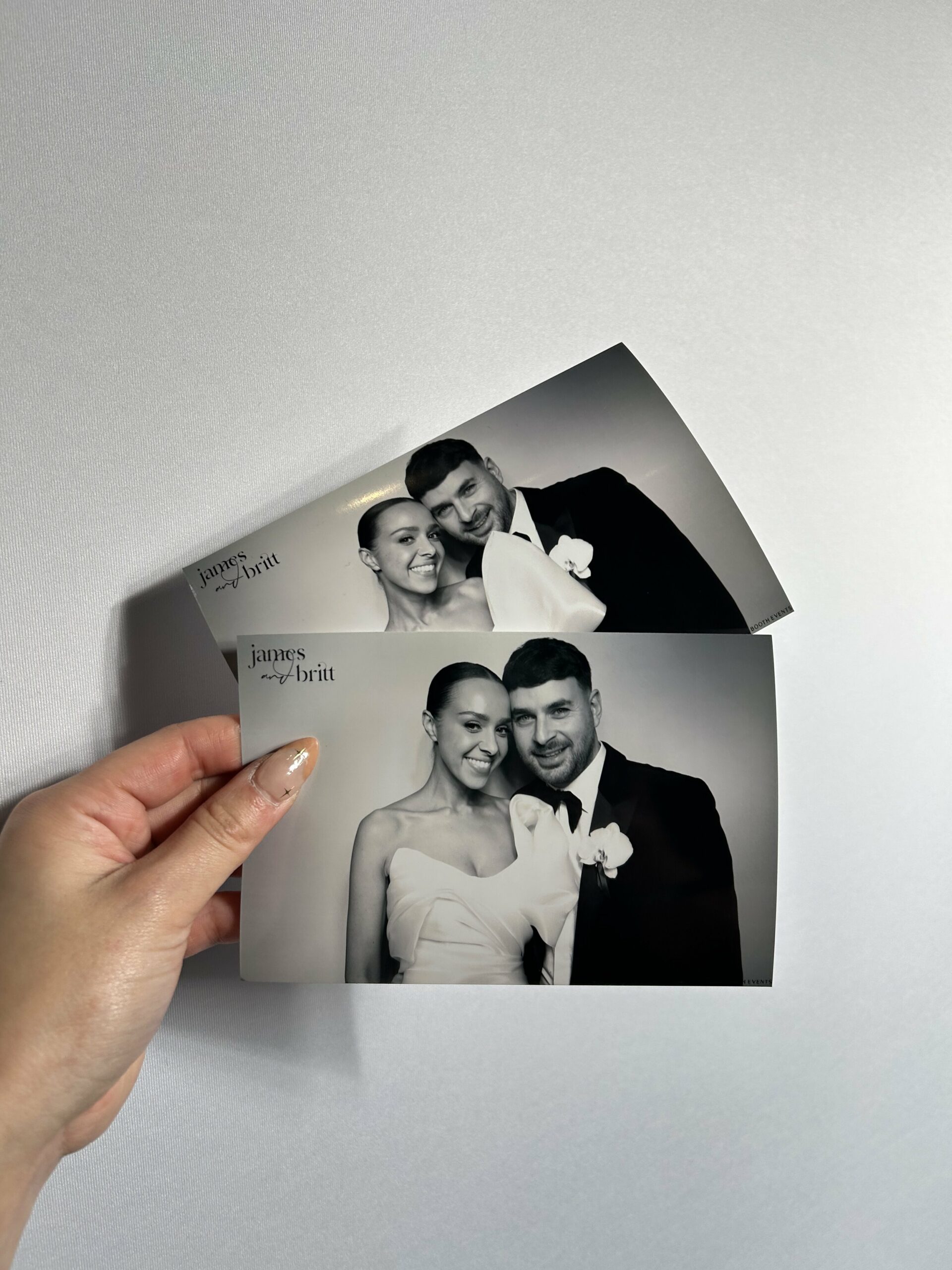
If your speech is funny, your photo booth strip probably will be too.
Example 3: The emotional bride speech (about 3 minutes)
“Hello everyone. I’ve practised this a lot, so if I stop halfway through, please just give me a second.
Thank you for being here. Looking out at this room, I can see every chapter of my life: my school friends, my uni friends, the people I work with, and the people who have known me since before I could walk. It means more than I can say that you’re all in one place tonight.
Mum. You raised my brother and me on your own for most of our lives, and you never once let us feel that anything was missing. You worked long days and still came to every netball game, every school concert and every parent-teacher interview, even the bad ones. Everything I know about loving someone, I learned from watching you. Today is as much yours as it is mine.
To Daniel’s mum and dad, thank you for making me feel like family long before today. Your house is always full and always welcoming, and I’m so proud to be part of it.
To my bridesmaids, thank you for holding my hand, literally and otherwise, over the last year.
Daniel. When we met, I was very good at looking after everyone else and not very good at letting anyone look after me. You changed that, slowly and patiently, without ever making me feel like I needed fixing. You made me a cup of tea every morning for a whole year while I studied, and you never once asked for anything back.
You are the calmest, kindest person I know. You are my safe place. And today, standing next to you, I have never felt more certain about anything.
I love you. Thank you for choosing me.
Everyone, please raise your glasses. To Daniel, and to love that shows up every single morning.”
Why it works: it is emotional without being vague. The speech is built on concrete moments (netball games, tea every morning) so the feeling comes from the detail, not from adjectives.
Example 4: The bride speaking alongside the groom (about 2 minutes, her half)
Many couples now give one shared speech or two short back-to-back speeches. In this version the groom has already thanked the guests, the suppliers and the wedding party, so the bride covers families and closes with the toast.
“Thanks, babe. I’ll take it from here, because if I let Marco keep going we’ll be eating dessert at midnight.
Marco has thanked the room, so I want to talk about our families.
To my parents. Dad, thank you for walking me down the aisle today, and for all the driving lessons that made you age ten years. Mum, thank you for the dress fittings, the phone calls and for crying at every single one of them. I love you both.
To Marco’s parents. Thank you for raising someone so generous, and for teaching him to cook, which, honestly, sealed the deal. Nonna, thank you for being here. Your blessing this morning meant the world to us.
And to my husband. That is the first time I’ve said that in public, and I like it. Marco, you are my best friend and my favourite person to come home to. Thank you for being patient, funny and completely yourself.
So, everyone, please stand if you can and raise your glasses. To our families, who made us who we are, and to the family we start today.”
Why it works: it divides the jobs cleanly, so nothing is repeated, and it ends with the toast so the couple finishes the formalities together.
Example 5: Honouring someone who could not be there (about 2 minutes 30 seconds)
“Good evening everyone. Thank you for being here to celebrate with us. Josh and I have looked forward to this night for a long time, and it is everything we hoped.
Before anything else, I want to take a moment for my dad. Dad passed away four years ago, and there hasn’t been a day of planning this wedding where I haven’t thought about him. He would have loved tonight. He would have loved the food, he would have told every one of you the same three jokes, and he would have been first on the dance floor and last off it.
I’m wearing his watch on my bouquet today, so in a small way he walked down the aisle with me.
Mum, you have carried our family with so much strength. Thank you for standing beside me today, and for every way you have held us together.
To Josh’s family, thank you for welcoming me so warmly, and for every Christmas I have spent at your table.
To the friends who got me through the hard years: you know who you are, and I love you.
And Josh. You met me at a time when I wasn’t sure I would feel this happy again. You never rushed me and you never let me feel alone. Dad only met you twice, but after the second time he told me, ‘That one’s a keeper.’ He was right about most things.
So please raise your glasses. To Josh, to the people we carry with us, and to a night full of the kind of joy Dad would have loved.”
Why it works: the tribute is early, brief and specific, then the speech moves forward to celebration. Guests take their cue from the bride: acknowledge, smile, then keep going.

The quiet, looking-at-each-other moment that a sincere speech is aiming for.
How to write your own bride speech
- Start with your partner, not the thank-yous. Write the 60 to 90 seconds about them first while you have the most energy, then build the rest around it.
- Pick one memory. One clear story with a time and a place beats three half-told ones. “The morning you drove to Torquay to bring me my forgotten passport” is better than “you’re always there for me”.
- Use names. “Thank you to my parents” is fine. “Thank you, Mum and Dad, Helen and Steve” is warmer and helps guests who do not know everyone.
- Keep one joke per section, maximum. The laugh you want is warm recognition, not shock.
- Read it aloud with a timer. If it runs over four minutes, cut thank-yous before you cut the part about your partner.
- Write the toast line last. It should name what you are toasting: your spouse, your families, the friends in the room.
If you are stuck on the first line, our list of wedding speech opening lines has 50 ideas, and our short wedding speeches post has quick examples for every speaker. For your partner’s side, see our groom speech examples, and if your best friend is writing her toast, send her our maid of honour speech template.
Delivery tips that actually help
- Print it. Large font, numbered pages, held in one hand. Phones lock and dim at the worst moment.
- Hold the glass, not the microphone stand. Ask your MC to hand you a mic and hold your notes and glass in the other hand, or leave the glass on the table until the toast.
- Look at your partner for the important part. You do not have to address the room the whole time. Turning to your partner for the sincere section is natural and photographs beautifully.
- Pause after jokes. Give the room a beat to laugh before the next line.
- Eat first. Speeches often fall between courses, and nerves on an empty stomach are no fun.
- If you cry, keep going. Take a breath, smile, and read the next line. The room is entirely on your side.
What to leave out
- Stories about exes, or anything that needs “you had to be there”
- Detailed thank-yous to every supplier by name (one line covers it)
- Wedding planning complaints, even funny ones about family
- Anything you would not want your grandparents or your partner’s boss to hear
Make room for everyone else’s words too
Only a handful of people give speeches, but most of your guests have something they would like to say to you. An audio guestbook lets them pick up a vintage-style phone and leave a voice message, and Ghost Booth Events has recorded more than 5,000 of those messages at Melbourne events. Pair it with a photo booth and you go home with their words and their faces. If you would like both at your reception, send us your date and we will check availability.
Bride speech questions
Does the bride have to give a speech?
No. It is entirely optional. Many brides now speak, either alone or alongside their partner, but a joint speech where your partner does most of the talking, or a single sentence and a toast, is just as valid. Do what feels comfortable.
How long should a bride speech be?
Two to four minutes suits most receptions, which is roughly 250 to 550 words read at a relaxed pace. A 90-second toast is perfectly fine if you would rather keep it brief. Time yourself reading aloud, because written words always take longer to say than you expect.
Should the bride or groom speak first?
There is no fixed rule. Many couples have the groom speak first and the bride close the formalities, but it can easily be the other way around. The main thing is to split the thank-yous so you are not repeating each other, and to agree who finishes with the toast.
Who should the bride thank in her speech?
Your guests, both sets of parents, anyone who helped with the wedding, the wedding party, the MC and speakers, and your suppliers in a single line. If your partner is also speaking, divide the list between you before the day so each person is thanked once, warmly.
How do I include someone who has passed away?
Mention them early, briefly and specifically: one or two sentences about who they were and how they are present today, such as a keepsake you are wearing. Then move the speech forward to celebration. Guests follow your lead, so a warm, steady mention is more comforting than a long tribute.