
TL;DR
- The formula: a short greeting, your names, then the date. Venue, monogram or one personal line are optional extras.
- Hierarchy: your names should be the largest line by a wide margin; greeting and date sit smaller above and below.
- Keep it short: aim for 20 words or fewer, with one name per line on a standard A1 sign.
- 50 examples below: classic, modern, funny, bilingual-friendly, unplugged ceremony and multi-day wording, all ready to copy and edit.
- Proof it twice: check spelling of names, accents in other languages and the day and date before anything is printed.
Good wedding welcome sign wording follows a simple formula: a short greeting, your names, then the date. Everything else, from the venue name to a funny line, is optional, and the best signs say less rather than more.
Below are 50 original wording examples grouped by style, followed by the layout rules that decide how much text actually fits on a sign. Swap in your own names, and use [Name] placeholders as a guide. For design inspiration to go with the words, see our wedding welcome sign ideas.
The anatomy of a welcome sign
Read top to bottom, most welcome signs have four parts:
- Greeting: “Welcome to the wedding of”, “Welcome” or a line in your own voice.
- Names: the hero of the sign. Usually first names, joined by “&”, “and” or “+”.
- Date: in Australia, day then month: “18.04.27”, “18 April 2027” or “Saturday, 18 April 2027”.
- Optional extras: the venue name, your monogram, a hashtag, a short verse or a practical line such as “Please find your seat”.
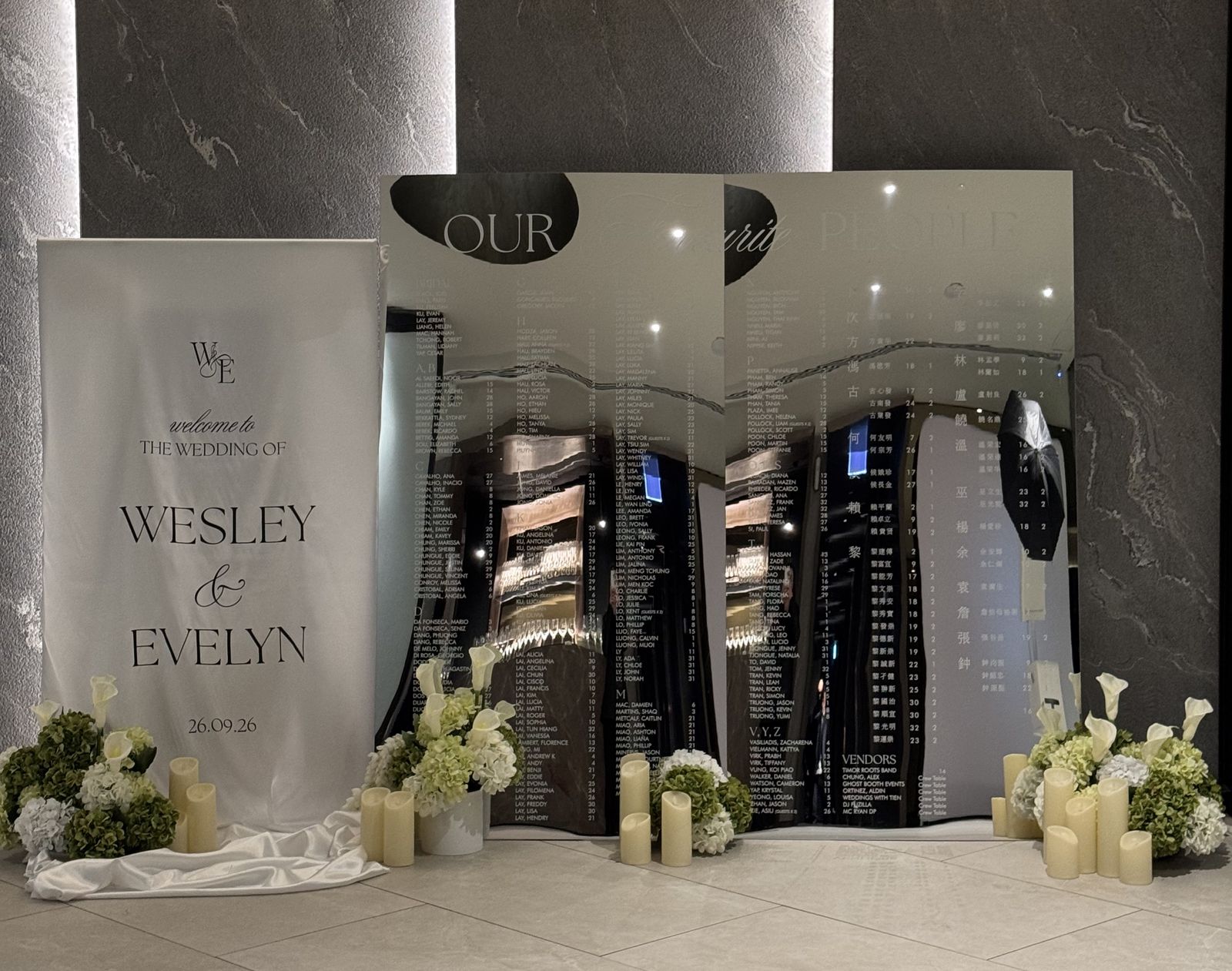
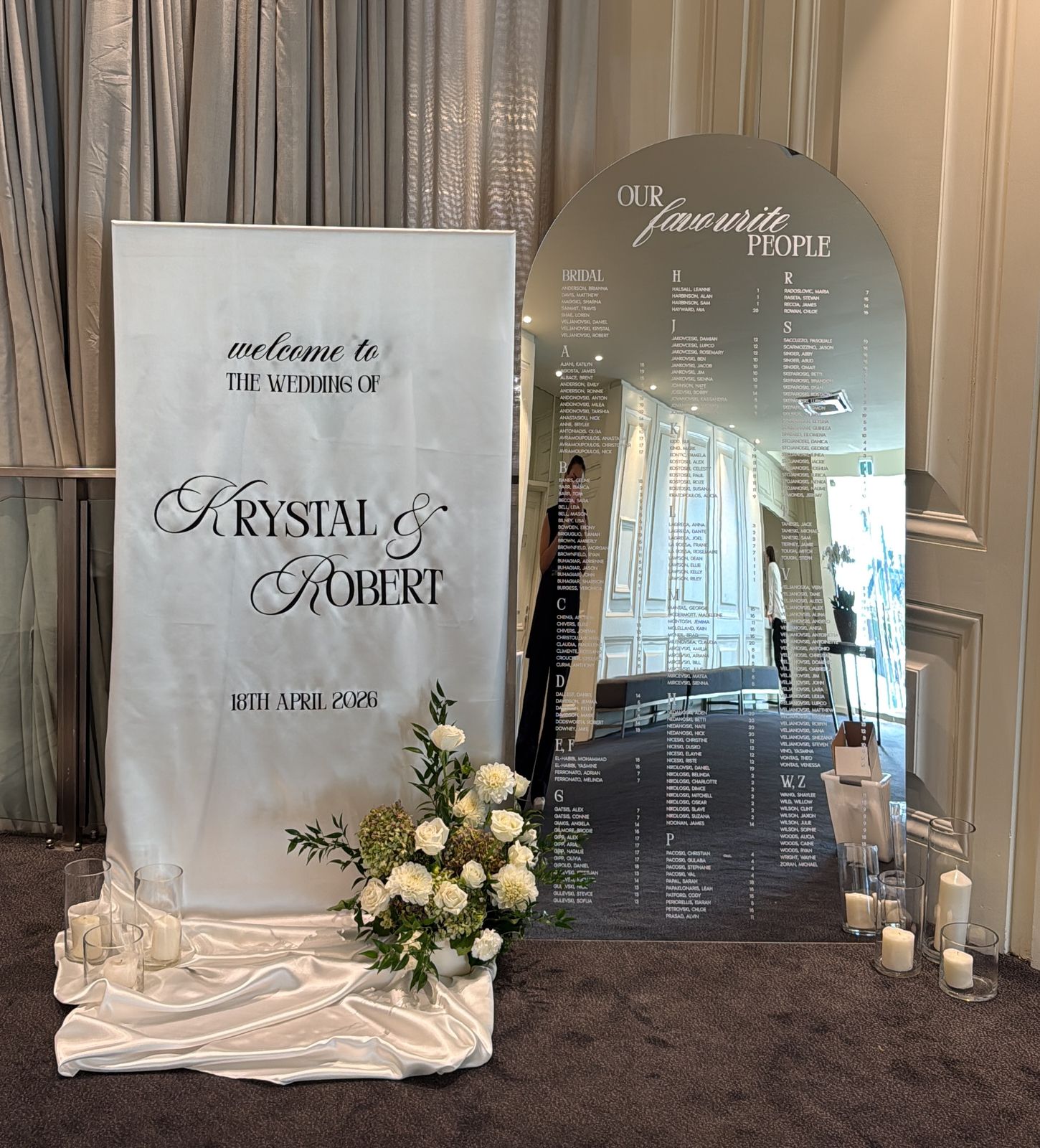
The hero photo above is a textbook example: a small script “welcome to”, a small capitals “the wedding of”, the names very large, and the date small at the bottom.
Classic wedding welcome sign wording
Timeless, formal and right for almost any venue.
- Welcome to the wedding of / [Name] & [Name] / [Date]
- Welcome / to the marriage of / [Name] and [Name] / [Venue] · [Date]
- Together with their families / [Name] & [Name] / welcome you to their wedding
- Please join us in celebrating / the marriage of / [Name] and [Name]
- Welcome to our wedding / [Name] & [Name] / [Day], [Date]
- The wedding celebration of / [Name] & [Name] / [Month] [Year]
- Welcome, family and friends / [Name] and [Name] / [Date]
- Thank you for being here / The wedding of / [Name] & [Name]
- Welcome to the ceremony of / [Name] and [Name] / [Time] · [Date]
- [Monogram] / Welcome to the wedding of / [Name] & [Name] / [Venue], [Date]
Modern wedding welcome sign wording
Shorter, warmer, a little more conversational.
- Hello, you made it. / [Name] & [Name] are getting married
- [Name] + [Name] / [Date] / So glad you’re here
- Welcome to day one of forever / [Name] & [Name]
- Come for the vows, stay for the dance floor / [Name] & [Name]
- Welcome. / Grab a drink. / Find your seat. / [Name] & [Name]
- We’re getting married today / [Name] & [Name] / [Date]
- The [Surname]s / Welcome / [Date]
- One love, one day, all of you / [Name] & [Name]
- Here’s to love, laughter and a very long night / [Name] & [Name]
- Welcome to the party / [Name] & [Name] / [Date]
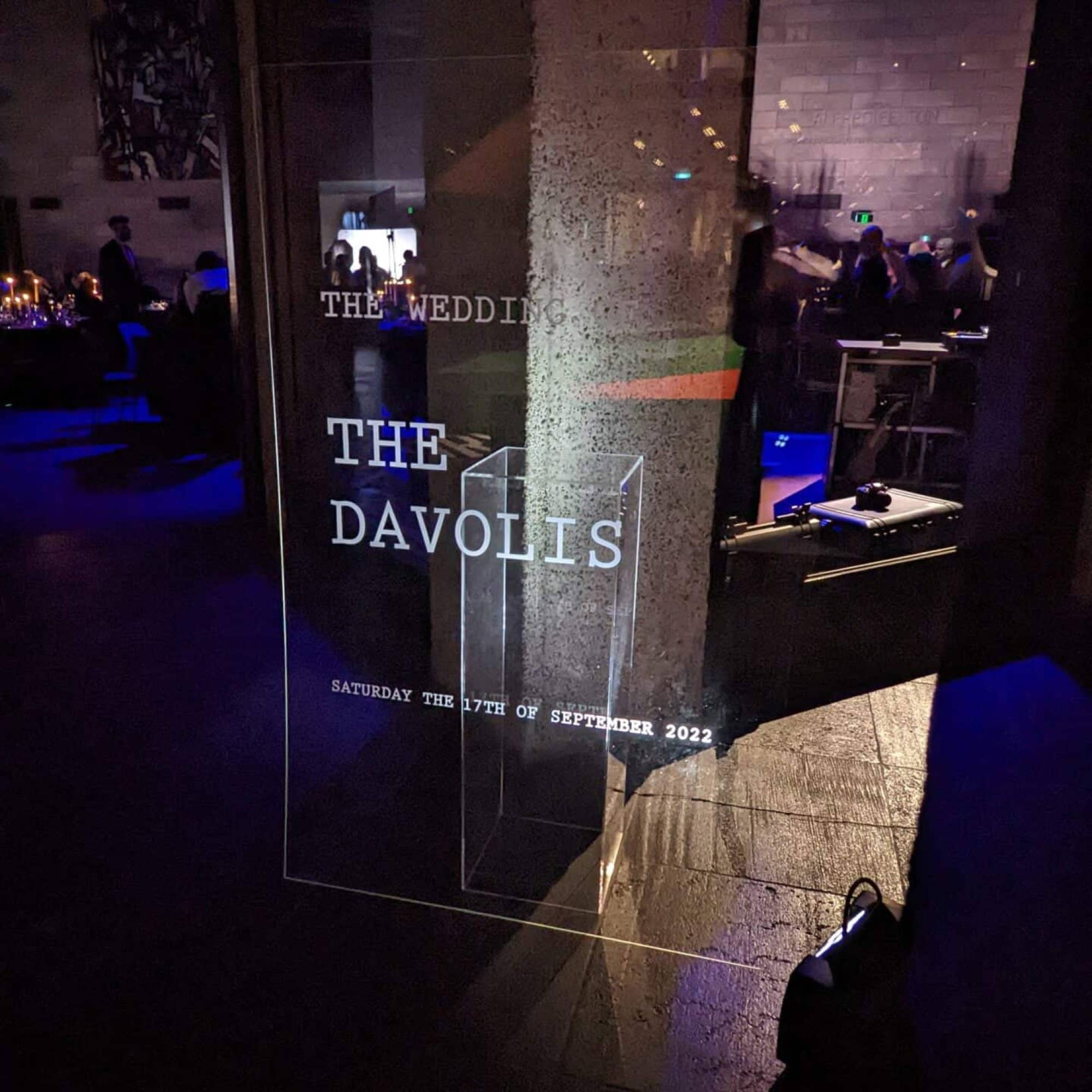
The surname style (example 17) on clear acrylic: short enough to set very large.
Funny wedding welcome sign wording
Humour works best when it sounds like the two of you. Keep the joke to one line and let the names stay the hero.
- Welcome to the wedding of [Name] & [Name] / Open bar. Closed to objections.
- Finally! / [Name] & [Name] / [Number] years in the making
- [Name] asked. [Name] said yes. We checked twice. / Welcome!
- Sit anywhere you like / (as long as it’s on the seating chart) / [Name] & [Name]
- Dance floor rules: no standing still / Welcome to the wedding of [Name] & [Name]
- [Name] & [Name] / Officially off the market as of [Time] today
- Welcome to our big [Heritage] wedding / Please pace yourself / [Name] & [Name]
- [Name] & [Name] / It took a while, but the food is worth it
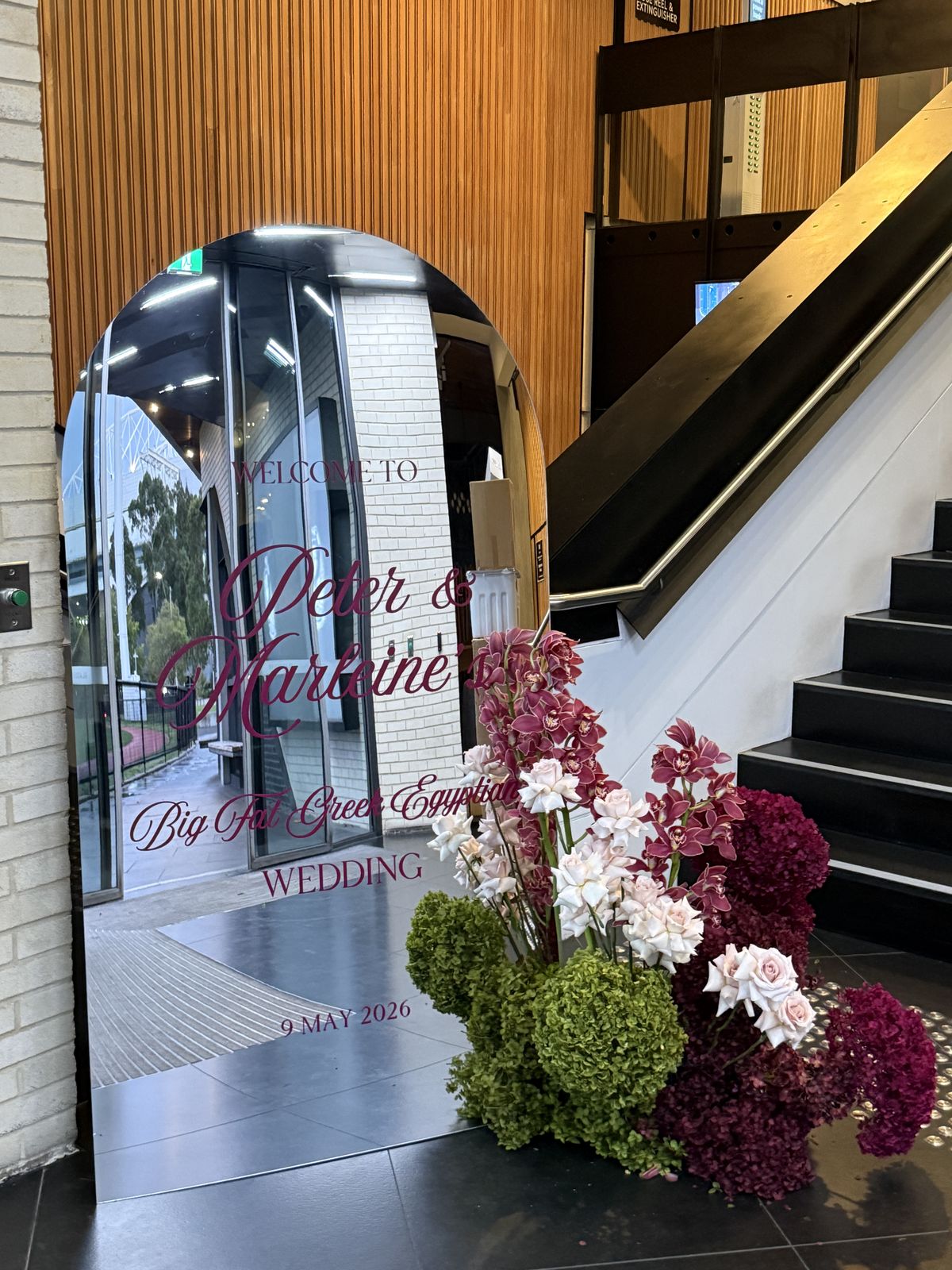
A real-life version of example 27: one playful line under the names says a lot about the night ahead.
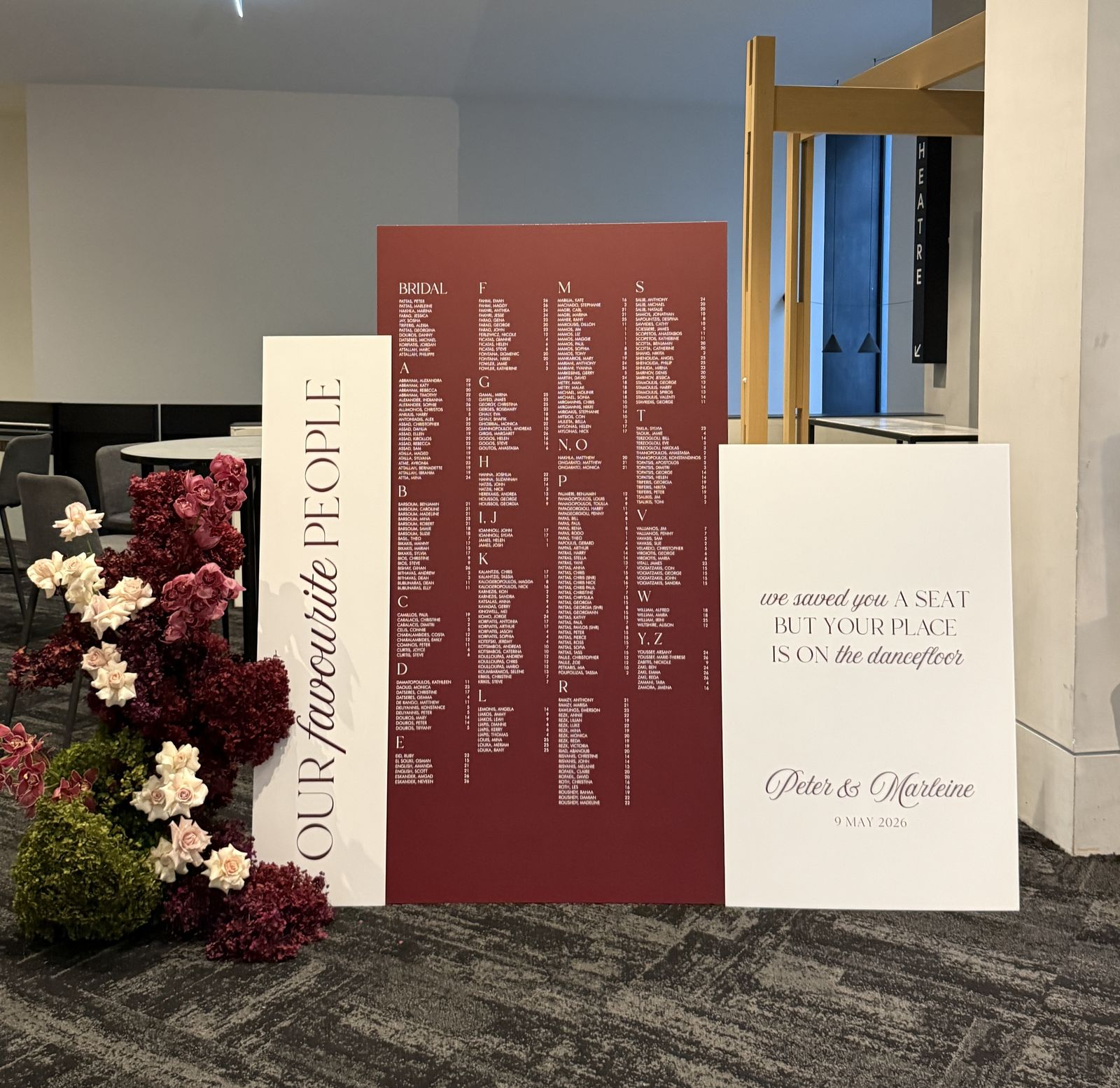
Light-hearted lines also work on a separate small sign beside the seating chart, so the welcome sign stays classic.
Cultural and bilingual-friendly wording
If your families speak more than one language, give each language equal weight rather than tucking one into small print. Always have a fluent speaker check spelling, accents and characters on the final proof.
- Welcome · Dobro došli / to the wedding of / [Name] & [Name]
- Benvenuti · Welcome / to the wedding of / [Name] e [Name]
- Καλώς ήρθατε · Welcome / to the wedding of / [Name] & [Name]
- Bienvenidos · Welcome / [Name] y [Name] / [Date]
- 囍 / Welcome to the wedding of / [Name] & [Name] / [Date]
- [Name] / [Name in original script] / & / [Name] / [Name in original script] / [Venue] · [Date]
- Two families, one celebration / The [Surname] and [Surname] families welcome you
- Welcome to the wedding of / [Name], [son or daughter] of [Parents’ names] / and / [Name], [son or daughter] of [Parents’ names]
A few notes on these: “Dobro došli” is used in Croatian, Serbian and Bosnian; “Benvenuti” is Italian, with “e” for “and”; “Καλώς ήρθατε” is Greek for “welcome”; “Bienvenidos” is Spanish, with “y” for “and”; and 囍 is the double happiness character traditionally used at Chinese weddings.
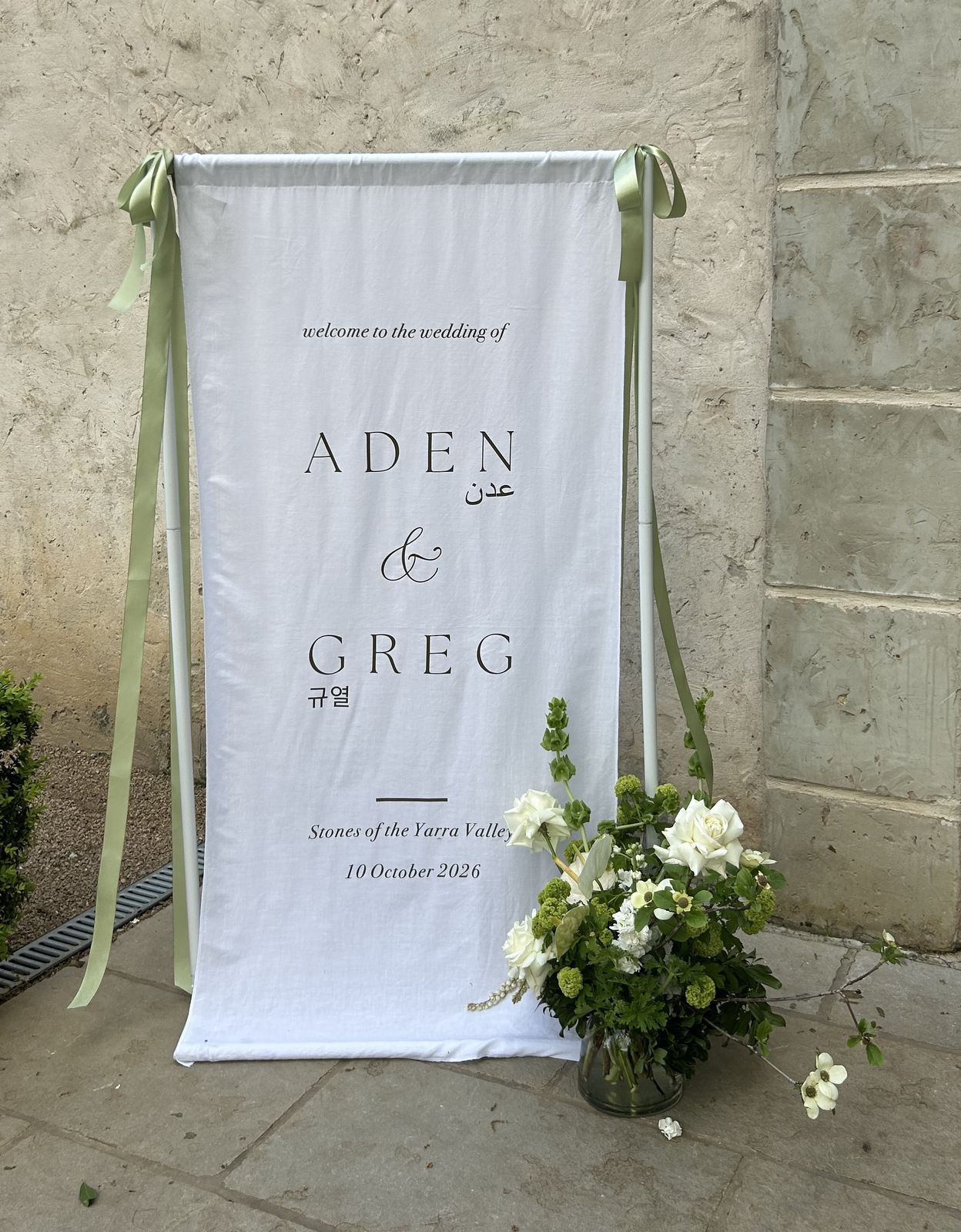
Example 34 in practice: each name in English with the same name in its original script beneath it.

A single word of greeting in Italian (“benvenuto”) above English wording keeps the sign simple and bilingual.
Unplugged ceremony wording
An unplugged ceremony sign sits at the entrance to the ceremony, separate from (or as well as) the main welcome sign. Make the request clearly and kindly, and tell guests when phones are welcome again.
- Welcome to our unplugged ceremony / Please switch off phones and cameras / Our photographer has it covered
- We’d love to see your faces, not your screens / Please keep phones away during the ceremony
- Be fully present with us / Phones away until we’ve walked back down the aisle
- The only thing we need you to capture today is the moment / Unplugged ceremony
- Phones down, hearts up / Every photo will be shared after the wedding
- Our photographer is the only one with a camera today / You’ll see every photo soon
- Unplugged ceremony / Please silence your phone / Snap away at the reception
If you are also writing your ceremony, our wedding ceremony script guide shows where your celebrant can repeat the unplugged request out loud.
Multi-day wedding welcome sign wording
For weddings with welcome drinks, a separate ceremony day or a recovery brunch, the welcome sign can double as a mini schedule.
- Welcome to the [Surname] & [Surname] wedding weekend / Friday: welcome drinks / Saturday: ceremony and reception / Sunday: recovery brunch
- [Name] & [Name] / Day one: [Event] / Day two: [Event] / Day three: [Event]
- Welcome to the wedding celebrations of / [Name] & [Name] / [Start date] to [End date]
- Tonight: welcome drinks / Tomorrow: we get married / Welcome to [Name] & [Name]’s weekend
- Thank you for travelling to celebrate with us / [Name] & [Name] / [Region] · [Dates]
- Welcome to day two / Last night we got married. Today we celebrate. / [Name] & [Name]
- Welcome to the wedding of / [Name] & [Name] / Ceremony [Date] · Reception [Date]
A multi-day schedule needs more text, so make the sign larger or move the timings to a separate order-of-events sign. Our wedding run sheet template helps you pin the timings down first.
Layout guidance: hierarchy and character limits
The wording you choose has to fit the sign at a size people can read. Ghost Booth Events welcome signs are most often A1 (594 × 841 mm), which reads clearly from about five metres. A widely used signage rule of thumb is about 25 mm of letter height for every 3 metres of viewing distance for comfortable reading (Digital Signage typography guide). Your names should be readable from the far end of that range; the greeting and date only need to be readable as guests walk closer.
On an A1 portrait sign, that works out roughly as follows. These are planning estimates; script and condensed fonts change the numbers.
| Line | Suggested height of capital letters | Roughly fits per line |
|---|---|---|
| Names | 60 to 90 mm | 7 to 10 capital letters, so one name per line |
| Greeting (“Welcome to the wedding of”) | 20 to 30 mm | 20 to 28 characters |
| Date, venue or extra line | 18 to 25 mm | 25 to 30 characters |
Rules we design to:
- Names are the hero. Make them at least two to three times the size of the greeting. If a name is long, give each name its own line and put “&” or “and” small between them.
- Aim for 20 words or fewer on a standard welcome sign. A funny line or verse counts towards that total.
- Use script for small words only. A flowing script looks beautiful for “welcome” or “and”, but long names in script are harder to read at a distance.
- Pick one date style and use it everywhere. Match the date format to your invitations: “18.04.27” is modern and compact, “Saturday, 18 April 2027” is formal.
- Check the day matches the date. It is an easy error to miss on a proof.
- Leave margins. Keep text well inside the edges, especially on arches, where the curve leaves less room at the top.
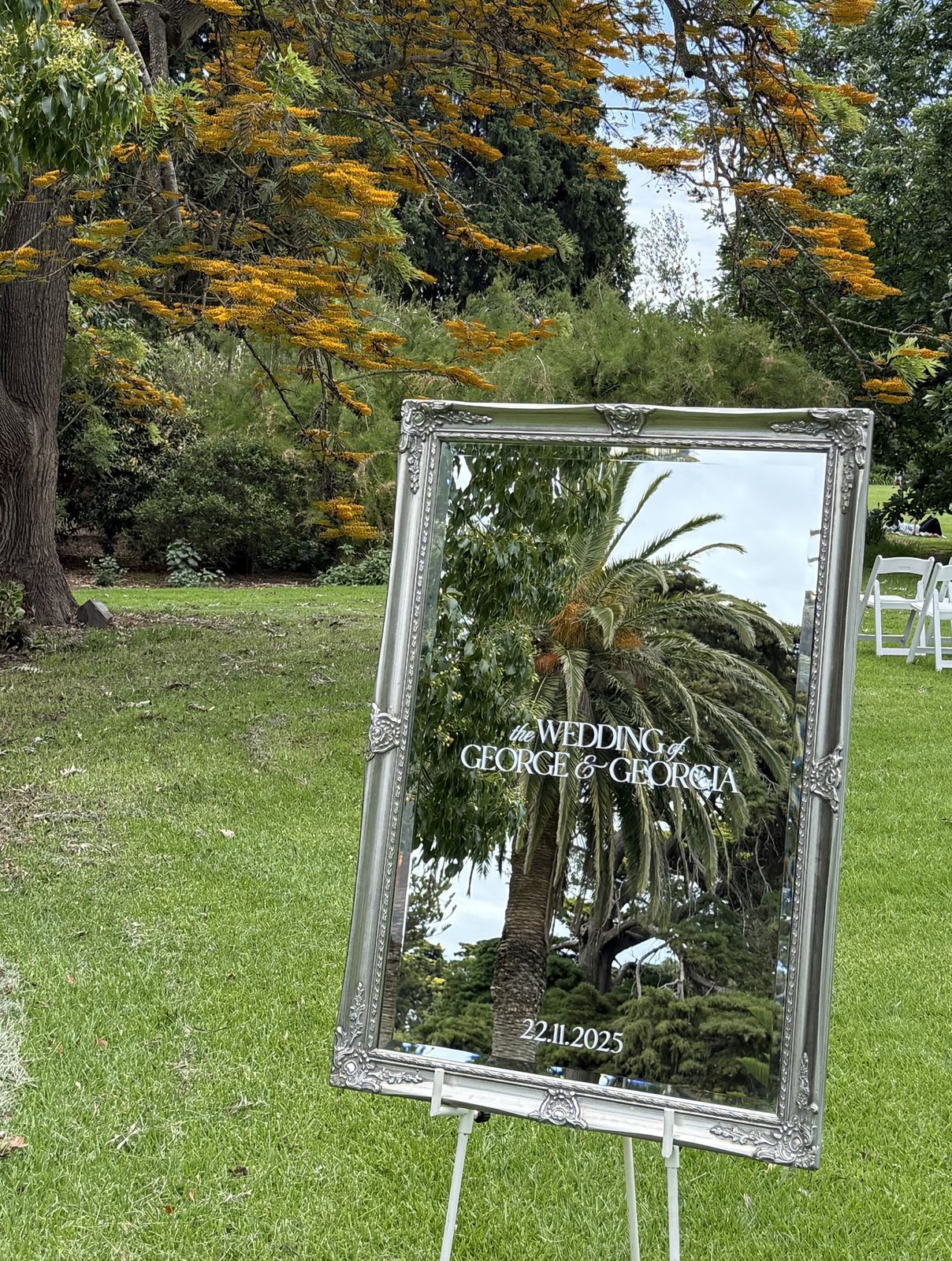
- Adjust for the material. On mirror and clear acrylic, use a heavier weight; reflections and see-through backgrounds make thin strokes disappear. Our mirror wedding signs guide covers legibility in detail.
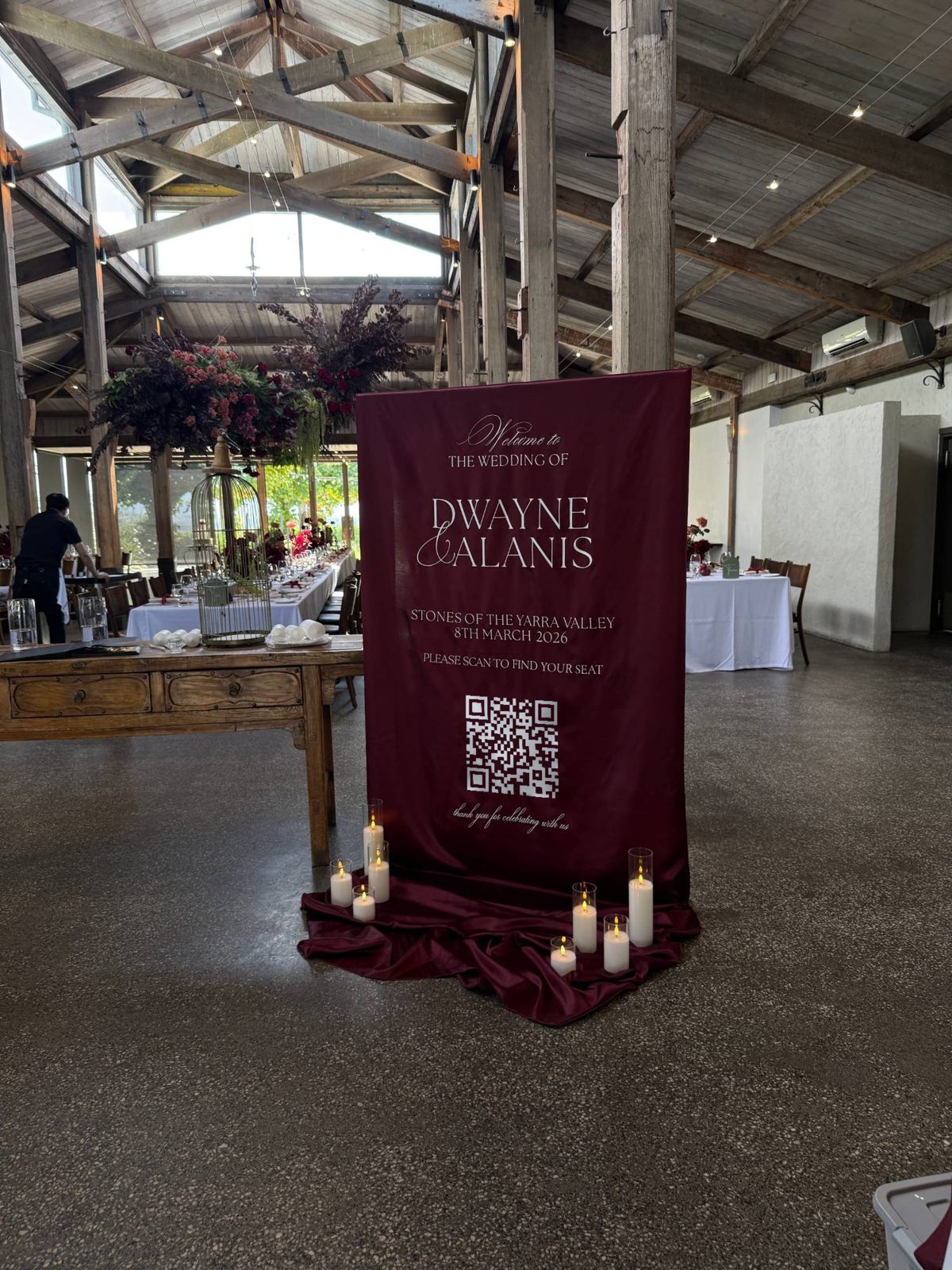
If your welcome sign will also carry a QR code for seating, add a short instruction such as “Please scan to find your seat” and leave clear space around the code. See our QR code seating chart for how that works.
Putting it on a sign
Every Ghost Booth Events sign starts from your invitation or moodboard so the fonts and colours match your stationery. You approve a digital proof of the exact wording and layout before anything is cut or printed, and production takes two to three weeks after approval. Choose from acrylic, mirror, satin, linen and foamboard, with wedding signage packages from $500.
For more ideas across the suite, read wedding signage ideas, wedding seating chart ideas and our wedding signage Melbourne guide. When your wording is ready, send it through with your date and we will turn it into a proof.
Welcome sign wording questions
What do you write on a wedding welcome sign?
A short greeting, your names and the date. "Welcome to the wedding of", followed by your first names and the date, is the classic version. You can add the venue name, your monogram or one short personal line if the design has room.
Whose name goes first on a wedding welcome sign?
There is no fixed rule. Many couples match the order used on their invitations so the whole stationery suite is consistent. Some choose the order that looks best visually, for example putting the shorter name first so the lines balance.
How many words should a welcome sign have?
Aim for 20 words or fewer on a standard A1 welcome sign. Guests usually read it in passing, and fewer words means your names can be set larger and read from further away.
Can a welcome sign be in two languages?
Yes. Put both greetings at the same size, or write each name in English with its original script underneath. Ask a fluent speaker to check spelling, accents and characters on the proof before it goes to print.
Should the date be written in numbers or words?
Either works. Numbers such as 18.04.27 look modern and compact; words such as Saturday, 18 April 2027 feel more formal. In Australia, write the day before the month, and match the style used on your invitations.